Reference input
Manually transcribed metadata. Its identifier maps to Extra on this import; check Report Number before citing.
Download RIS input ↗Executed study workflow · 20 October 2026
Follow a real report through Zotero, a Google Docs outline and three Anki cards. Inspect the files, the metadata correction and the limits of this small task.
Edited by Clinton Feyisitan
Review scope: native desktop and browser steps executed on 20 October 2026 using original demonstration text. No AI generation, students, assessed submission or learning outcomes tested.
How does the 2007 IES practice guide distinguish spaced review from quizzing? The source was chosen to demonstrate traceable reading notes. It is a dated research synthesis, not a current survey of every study technique or an evaluation of these products.
Pashler and six co-authors · September 2007 · NCER 2007-2004
Open the official report ↗Read the official IES report, its title/citation pages and recommendations. Recorded 2007 publication date and NCER 2007-2004. The PDF is a practice guide/evidence synthesis, not a new experiment.
passedZotero 10.0.6 imported one RIS item. The report number initially appeared in Extra; it was copied into Report Number before bibliography generation. The generated APA 7 HTML contains the identifier and all seven authors.
passed with a recorded correctionCreated a private Google Docs document using original demonstration text; saved to Drive and downloaded its native TXT export. The text includes source URL, recommendation/page references, outline and scope. No live Zotero citation integration was tested.
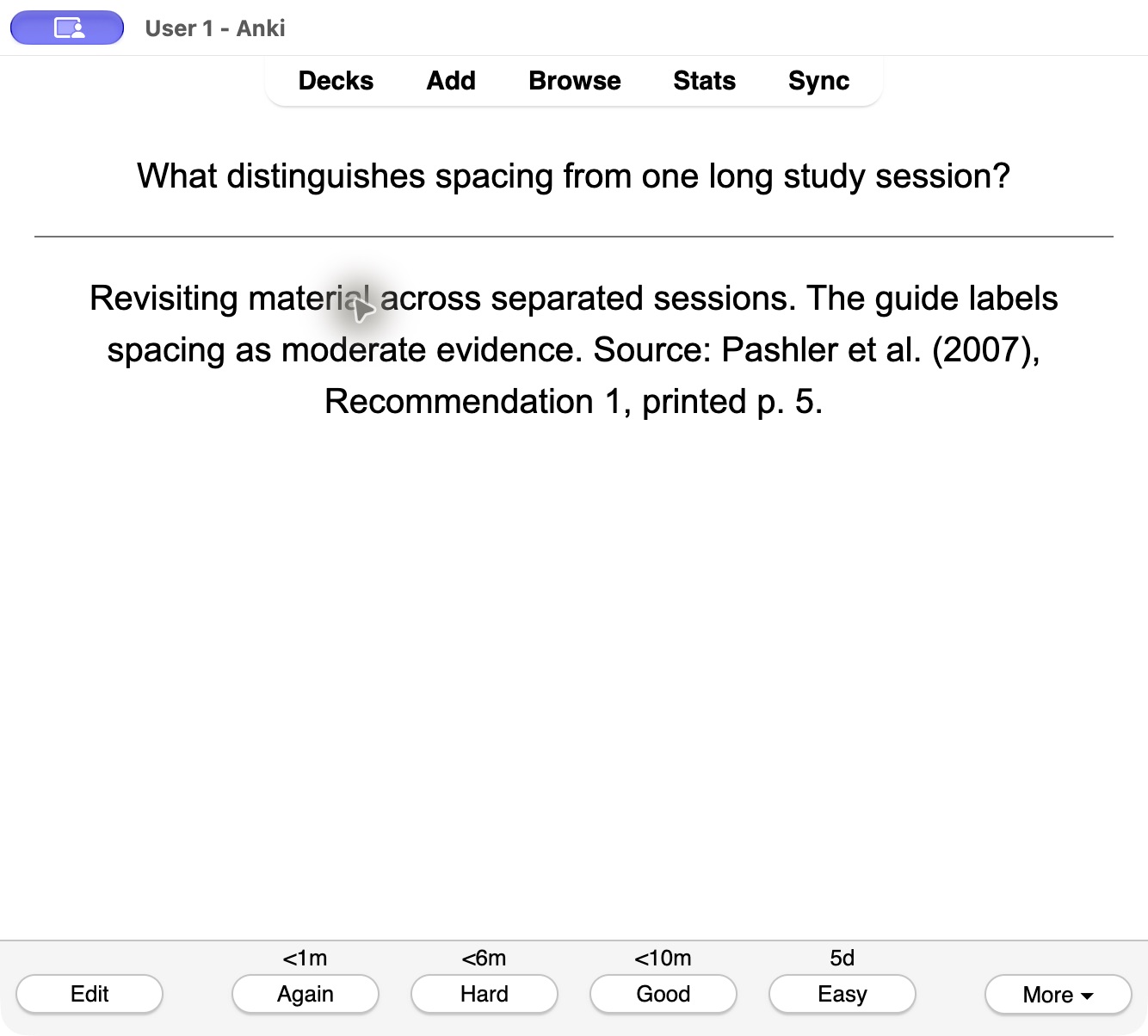
passed within scopeAnki 26.09.3 preview mapped Tab-separated Front and Back. All three notes were added to a dedicated example deck. Opened the first question and revealed the answer, preserving its source and printed page reference. No recall grade was recorded.
passed within scopeThe guide rates spaced learning as moderate evidence and its recommendation 5b about re-exposure through quizzes as strong evidence. Its pre-question recommendation 5a has a different rating. The outline and cards keep those statements separate. They do not claim Anki produced those findings.
Printed page numbers and PDF viewer page numbers differ: recommendation 1 begins on printed page 5 and recommendation 5b on printed page 21. Check the contents and the original passage rather than copying a viewer page number into a citation.
Manually transcribed metadata. Its identifier maps to Extra on this import; check Report Number before citing.
Download RIS input ↗Actual APA 7 bibliography HTML, generated after the report-number correction.
Download native HTML bibliography (ZIP) ↗Actual TXT download of the private outline. Plain text does not retain document styling or live citation fields.
Download native outline ↗Three original UTF-8 tab-separated questions and answers. The first answer includes a source and printed page.
Download card input ↗This is a suggested repeat procedure, not a timed promise. A source can require substantially more reading and checking than the small fixture here.
No student work or private course material was uploaded. No paid provider, trial, AI response, sync, collaboration, mobile app or long-term scheduling was tested. The Google account edition was not established. The Zotero connector was not installed and its live Google Docs integration was not exercised: the outline was a separate native document.
The products perform different steps. This is not a head-to-head winner, a grade-improvement claim or a new numerical ranking. For Elicit, Grammarly and Gemini Notebook, the linked assessments remain source-based.
Executed 20 October 2026 · Evidence policy · Suggest a correction